
 +44 20 8954 9881
 WF Planner
  WhatsApp
  Instagram
  OneID By WF
 - Home
- WF Code of Leadership 2018
Code of Leadership
Recommendations
Appendix A: Question and Answer from Najaf on Code of Leadership
Question
Answer
Appendix B: Original Persian Question and Answer from Najaf on Code of Leadership
Appendix C: Recommendations for Leaders
Introduction
Context
Role of Leadership
Qur’an-based Code of Practice for Leadership (Practical Guidance)
Summary of Recommendations for Leaders
All our institutions (Jamaats, Regional Federations, and The World Federation) are essentially religious organisations established for promoting the Shia Ithna-Asheri faith among its members and taking care of their spiritual upliftment and social well-being.
The primary objective of these organisations is to meet the religious needs of its members, which can be explained by referring to 3:104 of the Qur’an:
There has to be a nation among you summoning to the good, bidding what is
right, and forbidding what is wrong. It is they who are the felicitous.
As such, our constitutions stipulate that all activities of our organisations must conform to the Ja‘fari school of thought as explained by the Marja followed by the community. The community is also expecting this as ascertained in the Project North Star findings: 76-84% of community members and the electorate worldwide now expect their leaders to focus on the community’s religious and spiritual education (1)
Indeed, the community should be commended for developing this high sense of purpose in life since the purpose of creation is for Man to be tested how close he can get to His Lord (2) and he can best pass this test if he is learned, worshipful, and spiritual (3)
It is true that the positions held by the office-bearers of our organisations are not religious positions in which the fiqhi (jurisprudential) requirement of ‘adalah’ (justice, being of upright character) would be necessary, and that they are urfi (customary) and administrative positions. Nevertheless, by keeping the raison d’être of our institutions in mind, it is a given that our leaders should not, at the least, openly violate the fundamental teachings of our faith, especially the major sins which would place them in the category of fasiq (transgressor), who, according to fiqh, is discredited and hence his or her testimony is not acceptable. As the Qur’an says in 2:44:
Will you bid others to piety and forget yourselves, while you recite the Book? Do not you apply reason?
The fact that certain actions done in private life have a bearing on one’s official position can also be seen in Eastern cultures as well as in the legal systems of some Western countries: if an officer of a charity organisation declares personal bankruptcy, he or she is disqualified from holding the office, even though it was a personal matter.
Similarly, if an officer of a Shia Ithna-Asheri religious organisation openly commits a major sin in a personal capacity or openly supports such an activity by someone else, he or she does not deserve to hold that position. This is tantamount to spiritual bankruptcy and disqualifies the person from office.
Look at the recent examples of sexual harassment cases in the USA, Canada, and the UK: various high-ranking officials in the public and private sectors have had to resign for actions done in their private lives, which were mostly unrelated to their profession. These examples show that when a person occupies a seat of authority or leadership, there is an expectation that he or she will be a role model for others; and if they openly go against the core values of the organisation they represent, then they are no longer considered qualified for that position (4)
It is in the same spirit Grand Ayatullah al-Sayyid al-Sistani (may Allah protect him) has responded to the issue at hand by writing:
Although ‘adalah’ is not an essential requirement for them, it is necessary that they at least accept the indisputable laws of the shariah, be committed to them in practice, and refrain from openly going against the shariah in speech and action (5)
Therefore, it is hereby submitted to the Executive Council that:
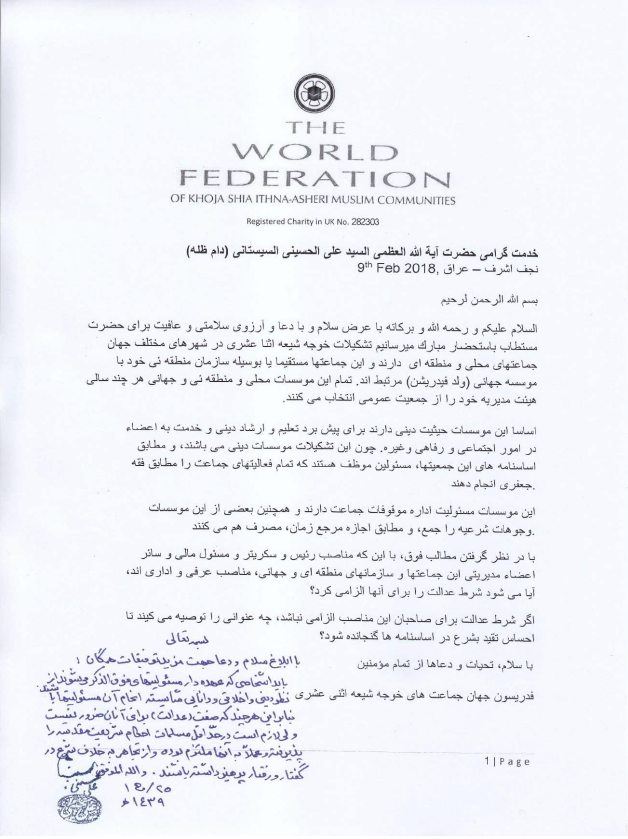
His Excellency, Grand Ayatullah al-Sayyid Ali al-Husayni al-Sistani (may Allah prolong his life)
Najaf Ashraf, Iraq. 9th Feb. 2018
Bismillahir rahmanir rahim.
Assalamu alaykum wa rahmatul lahi wa barakatuh.
With salams, duas, and wishes for Your Excellency’s good health and well-being:
We would respectfully like to inform you that the Khoja Shia Ithna-Asheri organisations have local and regional communities in different cities around the world. These communities are associated – either directly or through their regional federations – to a global organisation called ‘The World Federation’. Every few years, all these local, regional, and global institutions elect their office-bearers through the general public [of
their community].
Essentially, these institutions are religious organisations which further religious education and guidance, and provide services to their members in social, welfare, and other matters. As these organisations are religious institutions, in accordance with the constitutions of these communities the office-bearers are required to carry out all the activities of the community in accordance with Ja‘fari jurisprudence.
These institutions are responsible for the administration of the community’s charitable endowments (waqf), and some of these institutions also collect religious funds and use them in accordance with the permission (ijazah) of the Marja of the time.
Taking into consideration the above, whilst the positions of the president, secretary [and secretary general], treasurer, and other office-bearers of these communities and regional and global organisations are customary and administrative positions, can the condition of ‘adalah’ be made imperative for them [to be able to hold such positions]?
If the condition of ‘adalah’ is not imperative for those holding these positions, what terms would you advise so that a sense of commitment to the shariah is included in the constitutions [of these organisations]?
With salams, salutations, and duas from all the believers,
The World Federation of Khoja Shia Ithna-Asheri Communities
In the name of The Exalted.
With salams and duas for everyone’s tawfiqat to be increased:
People who have undertaken the responsibilities mentioned above must be appropriately qualified for carrying out those responsibilities in terms of their religiousness, morals, and knowledge. Therefore, although ‘adalah’ is not an essential requirement for them, it is necessary that they at least accept the indisputable laws of the shariah, be committed to them in practice, and refrain from openly going against the shariah in speech and action. And Allah is The Granter of Tawfiq (al-Muwaffiq).
Ali al-Husayni al-Sistani
25th Jumada al-Ula 1439 [11th February 2018]
Today, leadership tips can be obtained from many sources including politics, the military, sports, religion, and the business world. However, the advice presented can sometimes be misleading. Biographies of successful leaders, for example, offer universal success formulas which in reality can only be applied in certain situations; and top thinkers on leadership offer hypotheses which are sometimes contradictory.
There are thousands of books and articles on leadership. For example, some researchers reviewed 26,000 academic articles on leadership and found that they could distil these down to 90 variables for leadership success!6 Given all this available material on leadership, finding the right formula for success can be a bewildering task. But the surprising truth is that after fourteen centuries the best source for learning about leadership is still the divine wisdom revealed in God’s Final Message for mankind and exemplified in the words and actions of the Holy Prophet (s) and his holy progeny (a). Can anyone possibly teach and demonstrate for us better guidelines on leadership than the Creator of Man and His chosen representatives on Earth?
In light of this, what follows are some basic guidelines from the Holy Qur’an and traditions on a code of practice for community leadership. It is hoped that these guidelines will be studied carefully and adopted for practice, insha’Allah.
It is a sign of the Khoja community’s social maturity that it has been organising itself for decades. Jamaats have written constitutions, elected leaders, plans, and programmes for religious, social, economic, educational, and spiritual upliftment (7)
Shia Ithna-Asheri Khojas have been praised by our grand Maraji in Najaf and Qum (may God safeguard these centres of Shi‘i learning) as organised religious people with regular elections. This also means that community members as voters have a responsibility when they elect community leaders: they must elect those whom they believe to be trustworthy and God-fearing.
However, as Project North Star revealed, 76-84% of community members and the electorate worldwide now expect their leaders to focus on the community’s religious and spiritual education (8) Indeed, the community should be commended for developing this high sense of purpose in life since the purpose of creation is for Man to be tested how close he can get to His Lord (9) and he can best pass this test if he is learned, worshipful,
and spiritual (10)
Our humble advice to the community leadership is to review – from the perspective of the Qur’an and traditions – the role of leadership and the responsibility of leaders.
In 4:58, the All-Wise Lord exhorts us as follows:
Indeed, God commands you [O believers] to deliver the trusts to their [rightful] owners [including the trust placed by the electorate in the leaders they elect to run community affairs for God’s pleasure], and, when you judge between people [and govern them], to judge with fairness [and to govern with justice and equality]. Excellent indeed is what God advises you [no better advice on leadership and governance is possible]. Indeed, God is All-Hearing [to the victim’s plea], All-Seeing [of the responsible leader’s performance].
Divine Messengers are introduced in the Qur’an as ‘amin’. We find this with regard to Nabi Hud (a) in 7:68 and 26:125, Nabi Yusuf (a) in 12:54, Nabi Nuh (a) in 26:107, Nabi Salih (a) in 26:143, Nabi Lut (a) in 26:162, Nabi Shu‘aib (a) in 26:178, and Nabi Musa (a) in 44:18. And of course the Holy Prophet (s) was popularly known as ‘al-Amin’. One of the most authentic ziyarat which we can recite for any Imam (a) is Ziyarat Amin; this addresses the Prophet (s) as ‘Trustworthy’ in promulgating the divine message, protecting public property, honouring life, passing on the responsibility of Imamah to the next leader, and protecting divine secrets.
We have been warned by our spiritual masters, the Imams of Ahl al-Bayt (a), that:
Whosoever has been entrusted with an amanah, Iblis appoints a hundred devils from his rebellious supporters to misguide him and tempt him [to betray the trust] until they destroy him, except the one who is protected by God (11)
There is no effective divine protection or shield against Satan and his minions except that of iman (faith), taqwa (God-wariness), tawakkul (trust in God), (12) and surrendering to God’s will (13). Surrendering to God’s will is a state of mind, heart, and behaviour, and is termed in the Holy Qur’an and traditions as ‘taqwa’ and ‘adalah’ (justice).
A reverential fear of an All-Watching and All-Powerful God engenders a deep sense of responsibility to fulfil this trust. God says in 2:283:
So, if one of you trusts another, then he who is trusted should deliver his trust, and let him be careful of his duty to God, his Lord.
In some verses of the Holy Qur’an,(14) traditions,(15) and in fiqh, taqwa and adalah often refer to the same thing. In Islamic law, an ‘adil’ (just) person is:
Someone who does the things that are obligatory on him and refrains from doing the things that are unlawful for him. The sign of being ‘just’ is that one appears to be a good person, such that if local people, neighbours, or those who associate with him were to be asked about him, they would confirm his good character. (16)
Without taqwa, leaders are not considered role models. Even the wives of the Holy Prophet (s), who, although closest to him physically, were warned in the Qur’an that they have no status to be role models if they do not have taqwa.(17)
In the divine Muhammadan shariah, adalah is required as a religious obligation for some sensitive positions and tasks; for example, it is a requirement for being a Marja, an imam of congregational prayers, and a witness for the new crescent and divorce.
On the other hand, adalah is not required for some other positions, such as being a wasi (an executor of the bequest of a deceased person), unless the testator mandates it; for performing the qada (lapsed) prayers, fast, or hajj of a deceased person; and for collecting zakat, khums, and sadaqah.
As for the mutawalli (trustee) of waqf (charitable endowment) property, it is not obligatory for a Jamaat leader to have adalah to qualify as a leader elected by the community of believers if the endower or a Mujtahid giving permission does not stipulate it as a requirement.
It is definitely a moral and spiritual duty for a leader to possess taqwa and adalah because of the following reasons:
1. It helps the leader to exercise effective divinely supported leadership:
a. in decision-making: ‘O you who have faith! If you are wary of God, He shall appoint a criterion for you [so that you can distinguish between right and wrong beliefs, good and evil acts, and correct and incorrect opinions].’(18)
b. in solving difficult problems: ‘Whoever believes in God and the Last Day, and whoever is wary of God, He shall make a way out for him.’(19)
c. by providing him with unexpected economic prosperity: ‘And provide for him from whence he does not reckon.’(20)
2. As a religious community, we are all to prepare for the reappearance of the Awaited Saviour Imam Zaman (af), which is best achieved if we possess taqwa and good akhlaq and follow the path of Ahl al-Bayt (a).(21)
3. A Jamaat leader is also a representative of the community of the Ahl al-Bayt (a) followers. As Imam Ja‘far al-Sadiq (a) instructs, ‘Be a decoration for us and not an abomination on us.’(22)
4. Jamaat leaders are also custodians of waqf property entrusted to the Jamaat. As mentioned above, the trustee of waqf property is not required to be adil unless stipulated by the donor. However, the trustee must not act disloyally (for example, by not spending the income from endowed property in the way that was specified).(23)
5. A Jamaat leader is responsible for the financial management of community public funds:
a. the Holy Quran prohibits us from giving public funds to the ‘sufaha’ (immature and weak of understanding) (24)
b. the Best of Stories (ahsan al-qasas) of Nabi Yusuf (a) presents us with a model of qualification for managing financial affairs: ‘He said, ‘Put me in charge of the country’s treasuries. I am indeed fastidious [and] well- informed.’(25) This was because he possessed taqwa.(26)
6. The electorate are commanded not to follow a leader who openly sins.(27)
7. A Jamaat leader may be approached by a woman in distress, such as a wife who is suffering domestic abuse. The electorate needs to be assured that the woman would be respected and helped by a pious and just leader.(28)
8. Increasingly, Jamaat leaders are required to represent the community in inter-faith and global humanitarian forums. They must therefore be exemplary role models in the local and global community. The Qur’an tells us that we qualify to be the best of people if we profess the right belief and bid goodness and forbid evil in our words and deeds.(29)
9. Essentially, a community leader should aim for all his efforts, services, and sacrifices to be acceptable and rewardable by God, and to avoid a fate where good deeds are rendered scattered useless dust by the All-Powerful Lord due to the deliberate violation of His laws.30 Therefore, taqwa is essential if a leader seeks to please his Lord, which is only possible by submitting to His wise command.(31)
10. Ultimately, community leaders should realise that salvation from Hell-fire32 and attainment of the permanent pleasures of Paradise(33) are only possible through taqwa and adalah. Hell is the destination of those who defiantly follow their sinful desires, whereas Paradise is attained by wilfully and humbly submitting in public and private to the divine commands that have been legislated for our perfection.
This will be presented under the following seven categories:
1. Leadership qualifications
2. Staff selection and supervision 3. Threats to be aware of
4. Tasks to be performed
5. Method of leadership
6. Financial management
7. Previous leaders and policies
And [remind them, O Messenger] when God took the covenant of the Messengers, stating, ‘Verily, since I have given you the Book and The Wisdom, then whenever comes a Messenger to you confirming that which is with you, you should surely believe in him and help him.’ Then God stated, ‘Do you confess and accept to take up My burden of The Covenant which I lay upon you on that condition?’ They said, ‘We confess.’ God stated, ‘So, bear witness and I shall be with you among the witnesses.’(34)
Leadership is a sensitive position and can be exploited for ungodly purposes
Believers should not take the disbelievers as patrons and guardians instead of the believers.(35)
[O Messenger! (And so also ‘O believers!’)] And remember [yourself and mention to the ummah] Our obedient servants Ibrahim, Ishaq, and Ya‘qub who were bestowed with both [worshipful] strength and vision [to appreciate the profound truth of the divine purpose and plan].(36)
Say [O Messenger], ‘I do not say that I possess the treasures of God [so people should not expect to get unlimited services]. Nor that I know the Unseen [so leaders cannot answer all queries], and I do not say that I am an angel [I am just a simple human like you all]; [but say] I do not follow except what is revealed to Me [I am committed to act on divine guidance].’(37)
In order to be a model for others to look up to and follow, a leader should avoid being tainted with impurity.(38) This includes spiritual, mental, and behavioural impurity.
Such people would be likely to embezzle or misuse public funds.
God praises great men who are not distracted from performing prayers by trade and sale.(40)
Official work should not prevent a leader from performing his duties to his family and children.(41)
So [O Messenger] be steadfast [in faith, practise, inviting others to the religion, and defending it from attacks], just as you have been commanded [by God in the Holy Qur’an, and not for any worldly reason] – [you] and whoever has turned [to God] with you [those who have converted from polytheism and reverted from disobedience] – and do not overstep the bounds [by falling short or exceeding the limits]. Indeed, He sees best what you [people] do [so He will reward or punish you based on your degree of steadfastness].(42)
Without any exception, the Apostles and Messengers that We sent before you, when they aspired to spread the message of Truth, Satan would create obstacles; but God [in His Infinite Wisdom allowed it so that He] nullifies Satan’s efforts and then strengthens His messages; God is the All-Knowing All- Wise.(43)
And [O Messenger] pray for forgiveness for all believing men and women.(44)
And Isa said, ‘Who will be my helper to [the way of] God?’ The loyal dedicated Disciples said, ‘We are [not only your helpers but also] the helpers of God’s [way]; we believe in God; and you [O Isa] bear witness of our submission to Him.’(45)
And [remember] when you [O Messenger] left your household in the early morning to post the believers at their stations for the battle.(46)
And how excellent is the reward of those who act according to God’s commands!(47)
And Musa [personally] chose from his people seventy men for Our appointed place and time of meeting.(48)
When you were saying to the faithful, ‘Is it not enough for you that your Lord should aid you with three thousand angels sent down?’(49)
Indeed, God commands you [O believers] to deliver the trusts to their [rightful] owners.(50)
Imam Ali (a) says if someone promotes themselves when others are more meritorious, it is a betrayal of amanah!(51)
Leaders should facilitate obedience of God’s laws, enjoin good, and forbid evil
Those who [aid the religion of Allah], when We bestow them establishment and power on the earth, they establish prayer [facilitate the building of mosques and build a prayerful community], pay alms [provide welfare services,] and enjoin what is right [encourage virtue] and forbid what is wrong [strive to remove social, economic, and political vices]. And to Allah belongs the final decision about all issues [so He can grant success or defeat if they fail to perform].(52)
There has to be a nation among you summoning to the good, bidding what is right, and forbidding what is wrong. It is they who are the felicitous.(53)
Or have they [some Ahl al-Kitab] a share in the kingdom of the world? But then [if they had,] they would not give to the people even the slightest, not even [to the extent of] a speck in a date-stone.(54)
And Nabi Musa said [before leaving for his divine appointment on Tur Sina] to his brother Nabi Harun, ‘Take my place among my people [as the community cannot be without a leader during my absence]. Be upright and put things right [reform and reconcile between them], and do not follow the path of the corrupt mischief-makers! [Those who want to govern for selfish interests without guidance from divine wisdom].’(55)
[O Messenger! (And by extension, this also applies to Imams, their representatives, and those whohold ijazas.)] Take alms from their wealth in order to purify and sanctify them by it; and pray for them to God; verily, your invocations are a source of tranquillity for them; and God is the Knowing Hearer.(56)
After Fir‘awn and his army were drowned and the Children of Israel escaped from the seabed onto dry land, God ordered Musa (a) to divide them into twelve independent groups. Apparently, this was for the purposes of smoother administration, although they were all united in following Musa (a) as their leader and the Torah as their divine book.
We divided them [the Children of Israel] into twelve tribes and considered each of them a community [descended from Nabi Ya‘qub’s family]. When Musa’s people asked him for water [in times of need, people refer to divine representatives for divine help], We revealed to him, ‘Strike the rock with your [wooden] stick!’ Thereupon gushed forth [miraculously] twelve springs out of it, so each group knew its own place for water [so as not to overcrowd each other].(57)
For the present situation, God has lightened your burden of task [regarding troop numbers].(58)
God sent down His special grace [calmness and firmness] on His Messenger [who was worried about the flight of his followers] and on the believers [who were worried about defeat].(59)
A leader should be sharp in picking up signs of disbelief and in mobilising true defenders of faith.
And when Isa sensed their faithlessness, he said, ‘Who will be my helpers toward God?’(60)
And [We sent you as a guide and warner] lest – should an affliction visit them because of what their hands have sent ahead [of wrongdoings] – they should say, ‘Our Lord! Why did You not send us an apostle so that we might have followed Your signs and been among the faithful?’(61)
Hypocrites will misrepresent facts, oppose, spy, join forces with opponents, discourage, and break unity.
[O Messenger!] Even prior to this, they [the hypocrites] tried to cause trouble and to turn your affairs upside-down.(62)
Do not worry about false allegations from hypocrites about unfair distribution
They [the hypocrites] blame you [of being unfair, though you are a merciful messenger] about the distribution of welfare funds. They are pleased [with your fairness] when you give them something from it, but if they receive nothing [because they may have not deserved it or for some other reason], they become angry with you.(63)
Likewise [as you, O Messenger, have enemies such as Abu Jahl and Abu Sufyan], so did We assign for every Messenger in the past, enemies of jinn and humans [i.e. evil souls].(64)
They [Bani Isra’il] said, ‘We were tormented before you [Nabi Musa (a)] came to us [e.g. Fir‘awn would kill newborn male infants] and [also] after you came to us [e.g. women were enslaved).’ He said, ‘Maybe your Lord will destroy your enemy [depending on your piety and patience] and make you successors on the land [to inherit Fir‘awn’s palaces and riches], and then He will see how you act [test your ability to govern with God-given resources].’(65)
[O Messenger! Warn them about deviants.] Relate to them an account of him to whom We gave our signs [secret divine knowledge and the Greatest Name (ism a‘zam) so his duas were answered], but he cast them off [misused them to serve evil dictators]. Thereupon Satan pursued him [to misguide him even more], and he became one of the perverse [misguided damned deviants though he was among the guided ones before].(66)
Some of the townswomen said, ‘The chieftain’s wife has solicited her slave boy [for a romantic relationship]! He has captivated her love. Indeed, we see her to be in manifest error [for disgracing her social status by associating with a slave].’ (67)
And [your All-Wise Benevolent Lord has decreed:] do not come near adultery [do not even think about, look at, or touch another person unlawfully].(68)
How many a town We have destroyed that transgressed in its lifestyle [were proud and ungodly due to their over-indulgence]! There lie their dwellings [in ruins which the polytheists witness during their travels], uninhabited after them except by a few [temporarily during travel], and We were the [sole] inheritors [nobody remains to claim ownership other than Us].(69)
And [O Helpers of the Prophets (s),] how would you be faithless [and follow unqualified guides] while the signs of God [the Holy Qur’an] are recited to you and His Apostle is in your midst [and after the Holy Prophet, the Imams, followed by the Maraji during the Minor Occultation]? And whoever takes recourse in God [especially during confusing times and holds firmly onto God’s rope, i.e. the Qur’an and the Ahl al-Bayt (a)] is certainly guided to a straight path.(70)
And We wrote [ordained] for him [Musa] in the Tablets teachings of every kind [that are needed for guiding people including laws, warnings, rewards, history, and admonition] and explanations for everything [details of how laws are to be implemented]. And [We said to Musa,] ‘Hold these [divine lessons] with firmness [with your mind, heart, and body], and enjoin your people to do their best in holding fast to them [or follow them to the highest level, i.e. do not only perform the obligatory acts but perform the recommended ones as well]. Soon I will show you the abode of the disobedient ones [how Fir‘awn and his army will be defeated and the promised Holy Land will be cleansed of evil rulers].’(71)
Such is the design [the break of dawn, the night for resting in, and the precise movements of the sun and moon so that they can be referred to for calculations] of the All-Majestic All-Knowing.(72)
A major or urgent issue should not distract a leader from other important issues.
And the believers should not all collectively go out to fight [and abandon other duties]; of every group of them why should not a number proceed to acquire and study knowledge of religion?(73)
Surely, your Creator and Nurturer is God who created the heavens and the earth in six stages.(74)
The secret of success is faith, good deeds, patience, and trusting in God.(75)
O you who believe! Be you keepers of justice [in words and deeds and in all affairs, until it becomes a habit. So, do not commit any injustice [even against a non-Muslim] and be witnesses for God’s sake [not for worldly profit], even though it be against yourselves or your parents or your kinsmen.(76)
God has promised [through His Messenger] to those who believe and do good deeds that they shall have [great] forgiveness and a mighty reward.(77)
And [it was said to the Children of Israel after their repeated rebellion,] ‘Your Creator and Nurturer may bestow His mercy upon you; but if you return to rebellion, We too shall return to revenge; and We have made Hell a permanent prison for the disbelievers.’(78)
And when come to you those men who believe in Our signs, say [humbly and respectfully, O Messenger,) ‘Salamun alaykum’. Your Creator has prescribed mercy on Himself.(79)
Some of them [the hypocrites] speak ill of the Prophet, saying, ‘He listens to everything and believes what he hears.’ [But they do not realise the Holy Prophet (s) is so accommodating to everyone and eager to spread the truth to everyone! O Muhammad!] Tell them, ‘He only listens to what is good for you [rather than arrogantly ignore you,] and believes in God [who bids him to preach to all,] and has trust in believers [as righteous trustworthy companions,] and He is a mercy for the believers among you [as he does not disclose your dark secrets but instead tries to reform you].’(80)
[O Messenger!] God forgives you! Why did you give them leave [not to take part in the Tabuk Expedition before it was known to you which of them spoke the truth and [before] you had known who were the liars [when they brought the excuse of not being able to participate]?(81)
In the Qur’an, Nabi Sulayman (a) challenges his elite staff to bring Bilqis’ throne to him. Asif, who has ‘knowledge of the Book’, wins over Ifreet, the Jinn with fantastic powers.(82)
By the [angels, Messengers, or believers] ranged in ranks [to worship and obey the One True Lord].(83)
Nabi Sulayman (a) even employed jinn and birds.
[Once] Sulayman’s hosts were marched out for him, comprising jinn, humans, and birds, and they were held in check.(84)
[Then] God stated, ‘O Adam! Dwell you and your wife in The Garden, and eat of its fruits as much as you both wish, but do not approach this [particular] tree, otherwise both of you will be regarded as self-oppressors [and you will have to suffer the consequences, i.e. descent from here].’(85)
On the Day of Resurrection, We shall surely question those people to whom the Messengers were sent [how did you respond to the divine message], and We shall surely question the Messengers [about their delivery of the Message].(86)
Do not follow what you do not know for sure [such as rumours].(87)
Financial decisions should be made by the top officials in the organisation
[Rather than complain about lesser shares from public funds, it would have been better] if they had been pleased with what God and His Apostle gave them and had said, ‘God is sufficient for us [even if we do not receive from public funds]; God will give to us out of His grace, and His Apostle. Indeed, [we detach from worldly possessions and] to God do we eagerly turn [as He has the keys to the treasures of the Universe].’(88)
Beware of economic consequences when you obey God; but trust in God and He will enrich you
And if you fear poverty [due to cutting off trade with the polytheists], know that God will enrich you out of His bounty, if He wills [according to what is best for you]; verily, God is the All-Knowing All-Wise.(89)
And [Nabi Hud said,] ‘O my people! Ask forgiveness of your Creator and Nurturer [by believing and obeying Him] and turn repentant to Him [by regretting your evil past]. He will send down abundant rain regularly for you and He will add strength to your strength [in money and manpower]. And do not turn away [from the truth] out of sinfulness.’(90)
In the Qur’an, the King of Egypt consults with Nabi Yusuf (a),91 and Nabi Musa (a) consults with Nabi Shu‘ayb (a).(92)
Do not keep your hand chained to your neck [this is a parable of a stingy person who refuses to give anything; he acts like a prisoner whose hands are locked], nor open it altogether [and give away all your wealth and so become a burden on others], or you will sit blameworthy [before God and others], regretful, sad, destitute, and stripped-off.(93)
They said, ‘O Dhu al-Qarnayn! Gog and Magog are ravaging this land. Would you establish a barrier between us and them if we pay you a certain fee?’(94)
Do not say about anything, ‘I will indeed do it tomorrow’ unless God wills it [as Man’s ability and knowledge of all the factors necessary for success are limited compared to God’s unlimited knowledge and power].(95)
Then We gave you back the turn [to prevail] over them [the conquerors], and We aided you with children and wealth and made you greater in number [than your foes].(96)
The previous holy books, Tawrat, and Injil were taught to Nabi Isa (a).(97)
God took a covenant from previous messengers that they would believe in and help future messengers.(98)
God condemns blind acceptance and following irrational traditions of the past.(99)
How many a town We have destroyed! [Because the people rejected the true message and continued in sinful ways.](100)
1) leadership qualifications;
2) staff selection and supervision;
3) threats to be aware of;
4) tasks to be performed;
5) method of leadership;
6) financial management; and
7) previous leaders and policies.
1 PNS, p. 29
2 67:2
3 35:28
4 The Qur’an tells us not to obey a sinner (76:24).
5 See Appendix A: Question and Answer from Najaf on Code of Leadership.
6 Bruce Winston and Kathleen Patterson (2006), ‘An integrative definition of leadership’ in International Journal of Leadership Studies, vol. 1, issue 2, pp. 6-66.
7 In 57:25, we are told that God guides mankind with a constitution (‘the Book’), with divinely elected leaders (‘Apostles’) and plans, so that people can uphold justice and fairness.
8 PNS, p. 29.
9 67:2
10 35:28
11 Al-Saduq, al-Amali, p. 243, tradition 8. 12 16:99-100 and 7:201
13 36:60-61 and 17:65
14 5:8 and 65:2
15 See, for example, al-Saduq, Man La Yahdhuruhu al-Faqih, vol. 3, p. 38.
16 Al-Sayyid al-Sistani, Islamic Laws (2017, 3rd ed.), p. 4, ruling 2.
17 33:32. Without possessing taqwa, the wives of the Holy Prophet (s) would fall into the group of the impious wives of Nabi Lut (a) and Nabi Nuh (a), who are role models for the disbelievers (66:10), or the wives of Imam Hasan (a) and Imam Jawad (a).
18 8:29
19 65:2. Imam al-Sadiq (a) says if people were to act on this one verse it would suffice them!
20 65:3. Imam Ali (a) says be more hopeful in what you expect than in what you do not expect, for Musa (a) son of Imran (a) left his family to get some fire (for light and warmth in the dark cold night of the desert) but instead God spoke with him and he returned as a messenger. The Queen of Sheba departed (to meet Nabi Sulayman (a)) but she accepted Islam at his hands. And the magicians of Fir‘awn came out seeking to promote his glory but returned as believers!
21 Imam al-Sadiq (a) says the duty of the companions of Imam Zaman (af) is to proclaim the shahadtayn (the two testimonies), profess wilayah of the Ahl al-Bayt (a), dissociate themselves from their enemies, submit totally to their authority, strive to do their best, await the reappearance, practice the highest level of taqwa, and display good akhlaq. (Al-Nu‘mani, al-Ghaybah, p. 200, tradition 16)
22 Al-Saduq, al-Amali, p. 400, tradition 17. The Sixth Imam (a) also says, ‘Decorate yourself with the higher degree of taqwa. May God grant you all His special grace and defeat our enemies [with this spiritual weapon].’ (Al-Kulayni, al-Kafi, vol. 2, p. 78, tradition 13)
23 Al-Sayyid al-Sistani, Minhaj al-Salihin, vol. 2, ruling 1501, and Islamic Laws (2017, 3rd ed.), p. 720, ruling 2707.
24 4:5
25 12:55
26 12:57 and 12:90
27 18:28 and 76:24
28 9:71. ‘And the believers, men and women are supporters and helpers of one another.’ Referring to this verse, Imam al-Sadiq (a) says believing women should feel safe (for their honour) in the company of believing men. (Tafsir al-Ayyashi, vol. 2, p. 96)
29 3:110
30 25:24
31 5:27
32 19:63
33 19:72
34 3:81. We can appreciate the importance of taking a covenant from this divine model: when God appoints His Messengers to work as leaders who must be obeyed, He takes an oath from them committing them to carry out their duties faithfully.
35 3:28
36 38:45
37 6:50
38 74:5
39 26:151. ‘Musrifin’ in this verse refers to extravagant leaders who are excessive in sinning and oppress their loyal obedient subordinates, as was the case with Bani Umayyah and Bani Abbas.
40 24:37. Imam al-Sadiq (a) says this verse refers to traders who are not distracted from prayers by their trade, and so at prayer time they would abandon trade for prayers and thereby qualify for a greater reward than non-trader worshippers! (Al-Kulayni, al-Kafi, vol. 5, p. 75, tradition 8)
41 66:6. And in 19:55, we are told that Nabi Isma‘il (a) would continuously bid his spouse and children to pray and pay the religious tax (as these need constant reminders and are two important pillars of divine faiths). This was a sign of him being pleasing to God and being approved and accepted by Him.
42 11:112
43 22:52
44 47:19
45 3:52
46 3:121
47 3:136
48 7:155
49 3:124
50 4:58
51 Al-Amini, al-Ghadir, vol. 8.
52 22:41
53 3:104
54 4:53
55 7:142
56 9:103
57 7:160
58 8:66
59 9:26
60 3:52
61 28:47
62 9:48
63 9:58. Imam al-Sadiq (a) says this verse refers to two-thirds of people. (Tafsir al-Ayyashi, vol. 2, p. 89, tradition 62).
64 6:112
65 7:129
66 7:175
67 12:30
68 17:32
69 28:58
70 3:101
71 7:145
72 6:96
73 9:122
74 7:54, 10:3, 11:7, 25:59, 32:4, 50:38, and 57:4
75 29:58-9
76 4:135
77 5:09
78 17:8
79 6:54
80 9:61
81 9:43
82 27:38-40
83 37:1
84 27:17
85 7:19
86 7:6
87 17:36
88 9:59
89 9:28
90 11:52
91 12:50 and 12:54. The King was impressed with Nabi Yusuf (a) as he had interpreted expertly without any fee. He was also impressed by Nabi Yusuf’s honesty, purity, and ability. He therefore requested to meet Nabi Yusuf to appoint him as his special personal royal advisor. After assessing him by means of a personal interview, Nabi Yusuf was declared a special trustworthy person above all, and he was given authority over all the resources.
92 28:25
93 17:29
94 18:94
95 18:23-24
96 17:6
97 3:48
98 3:81
99 2:170
100 7:4

Stay Connected
Sign up to our emails and be the first to know about our latest projects and how you can get involved.
