
 +44 20 8954 9881
 WF Planner
  WhatsApp
  Instagram
  OneID By WF
(1930–2026)
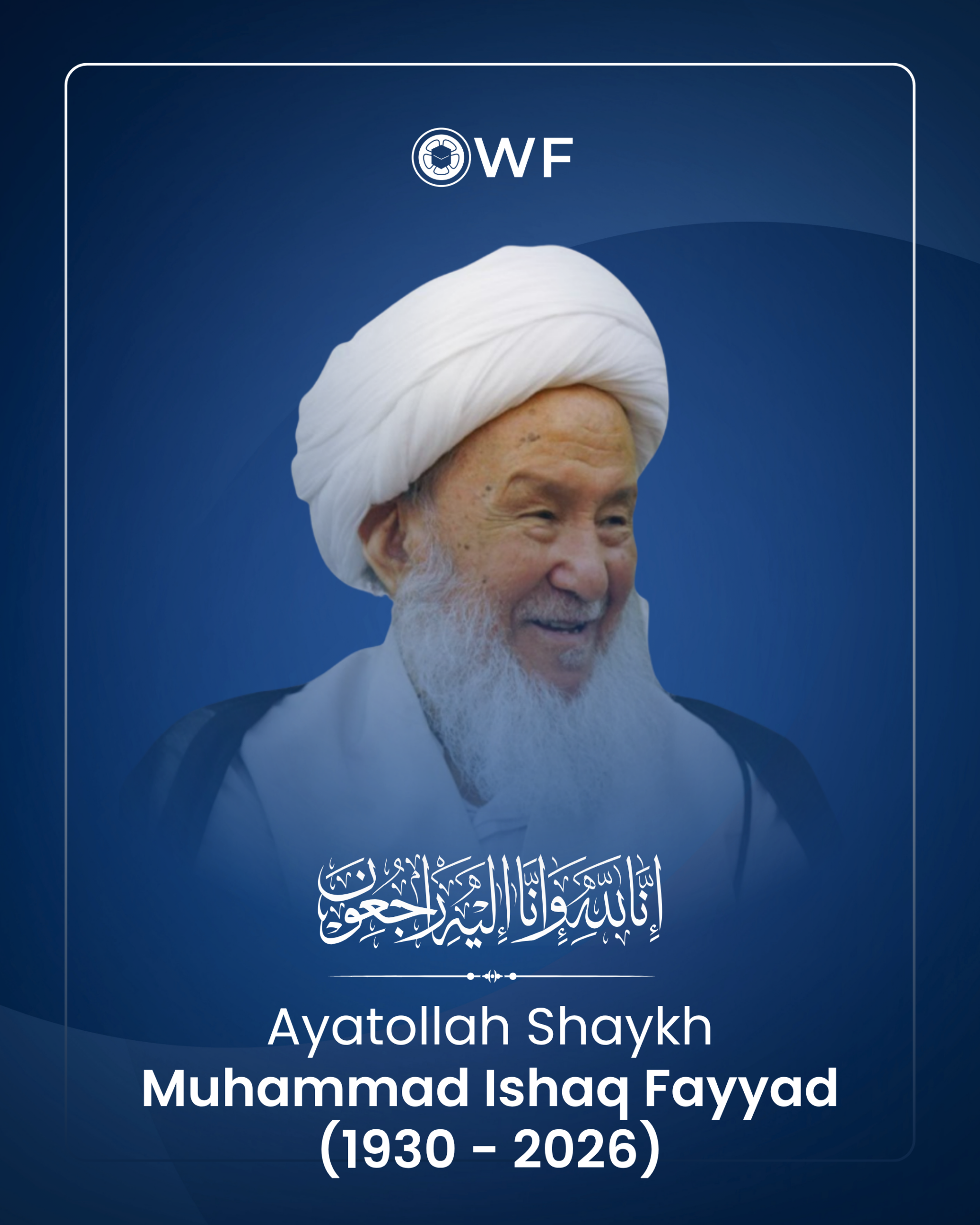
Grand Ayatollah Shaykh Muhammad Ishaq al-Fayyad
The World Federation of KSIMC extends its deepest condolences to the Imam of our Time (may Allah hasten his reappearance), our marājaʿ and our scholars, and to the entire Muslim Ummah on the passing of Grand Ayatollah Shaykh Muhammad Ishaq al-Fayyad — one of the four most senior marājaʿ (sources of emulation) of the seminary in the holy city of Najaf, and a pre-eminent student of Sayyid Abu al-Qasim al-Khoei. He passed away on Thursday, 4 June 2026, in Baghdad, at the age of 96. He will be laid to rest in Najaf, the city he arrived in as a teenager and in which he remained for the rest of his life. In his honour, Iraq has declared three days of national mourning.
For decades, Shaykh al-Fayyad stood among the “four grand ayatollahs” of Najaf, alongside Sayyid Ali al-Sistani, Sayyid Muhammad Saeed al-Hakim (d. 2021), and Shaykh Bashir al-Najafi, as pillars of the seminary in Najaf. He was also a figure without precedent: the most senior marjaʿ when Sayyid al-Khoei died in 1992, it was Shaykh al-Fayyad and his peers who upheld Sayyid al-Sistani as head of the Najaf marjaʿiyya.
He was born in 1930 in the village of Ṣūba, in the Jaghori district of Ghazni province in central Afghanistan, the son of a poor Hazara farmer. In the harsh mountain winters, his father would carry him on his back through the snow to the school run by the village shaykh, where he learned to read and recite the Qurʾan. Drawn by what he had heard of Najaf and of its head Sayyid al-Khoei, he set out alone overland, passing through Mashhad, Qom, and Basra, and arrived in Najaf at around eighteen, knowing little Arabic and with almost nothing to his name.
His intellectual ability allowed him to progress through the Hawza curriculum swiftly, before attending the advanced lectures in jurisprudence and legal theory (baḥth al-khārij) of Sayyid al-Khoei for fifteen unbroken years. Following his attendance in the advanced lessons, he wrote Muḥāḍarāt fī Uṣūl al-Fiqh while still in his early thirties, a book in which he demonstrated his scholarly abilities and one that was considered the most thorough and widely studied transcription of Sayyid al-Khoei’s lectures on legal theory. Sayyid al-Khoei’s own endorsement — praising the young scholar’s “eloquent style and a command worthy of admiration” — is preserved at the front of the book. When some objected that its author was too young, and a foreigner, al-Khoei is said to have answered that the only measure of a scholar is his knowledge and his merit, not his age or his origin. The Muḥāḍarāt remains a standard reference in seminaries to this day.
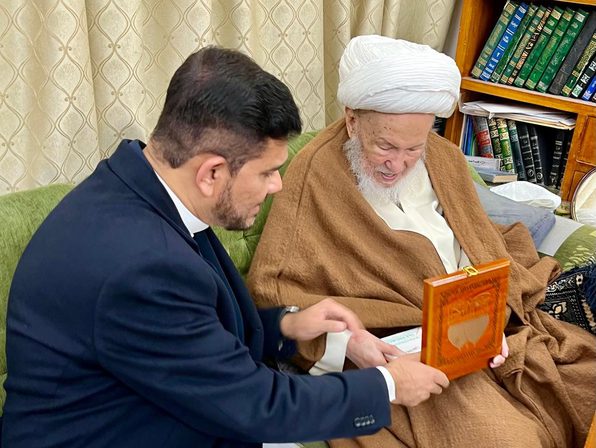
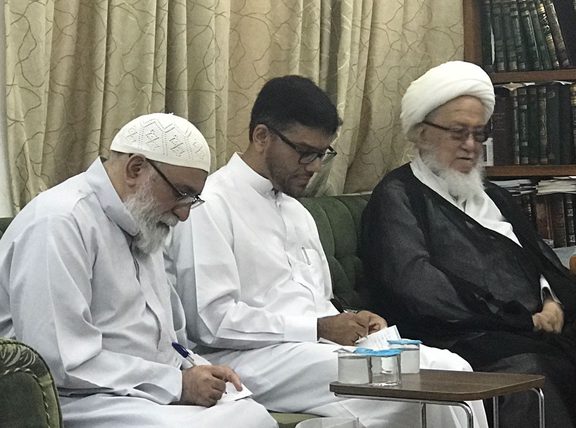
For over half a century, the Shaykh taught in Najaf — at the Hindi Mosque, at Dār al-ʿIlm, and at the Yazdī school — training generations of scholars. For more than twenty-five years, until Sayyid al-Khoei’s death, he served on his teacher’s istiftāʾ (juristic response) committee, alongside men who would themselves go on to become marājaʿ. As a marjaʿ in his own right, he guided followers across the world; his manual of practical law, Tawḍīḥ al-Masāʾil, was translated into English, Persian, and Urdu, and his published corpus runs to some two dozen titles, among them his ten-volume gloss on al-ʿUrwa al-Wuthqā, the fourteen-volume al-Mabāḥith al-Uṣūliyya, and Minhāj al-Ṣāliḥīn. His scholarship reached into the dilemmas of modern medicine: in al-Masāʾil al-Ṭibbiyya (Medical Issues) he addressed the jurisprudence of brain death, organ transplantation, assisted reproduction, cloning, and stem-cell research. His written works include the following:
-
Muḥāḍarāt fī Uṣūl al-Fiqh (Lectures on the Principles of Jurisprudence) — his transcription of Sayyid al-Khoei’s uṣūl lectures and the work that made his name; 10 volumes (5 printed in the original run, later reissued within Mawsūʿat al-Imām al-Khūʾī).
-
al-Mabāḥith al-Uṣūliyya (Investigations in Legal Theory) — his own independent cycle on legal theory (uṣūl); 14 volumes (13 printed).
-
al-Naẓra al-Khāṭifa fī al-Ijtihād (A Capturing Glance at Ijtihād) — a short treatise on the theory of legal reasoning.
-
Minhāj al-Ṣāliḥīn (The Path of the Righteous) — his comprehensive risāla ʿamaliyya (manual of practical law); 3 volumes.
-
Taʿālīq Mabsūṭa ʿalā al-ʿUrwa al-Wuthqā (Extensive Glosses on al-ʿUrwa al-Wuthqā) — detailed annotations on Yazdī’s classic legal compendium; 10 volumes.
-
al-Istiftāʾāt al-Sharʿiyya (Juristic Responses) — collected answers to followers’ questions.
-
Manāsik al-Ḥajj (Rites of the Pilgrimage) — with an abridged version (Mukhtaṣar Manāsik al-Ḥajj) and a Persian edition.
-
al-Arāḍī (Land) — jurisprudence of landholding and land law.
-
Tawḍīḥ al-Masāʾil (Clarification of Rulings) — his practical-law manual in the Persian risāla style; translated into English, Persian, and Urdu.
-
al-Masāʾil al-Mustaḥdatha (Newly-Arising Issues) — rulings on modern matters not treated in the classical sources.
-
al-Masāʾil al-Ṭibbiyya (Medical Issues) — biomedical ethics: brain death, organ transplantation, blood transfusion, contraception, assisted reproduction, cloning, stem-cell research, autopsy, and more.
-
Aḥkām al-Bunūk (Rulings on Banks) — Islamic banking and finance.
-
Mawqiʿ al-Marʾa fī al-Niẓām al-Siyāsī al-Islāmī (The Position of Women in the Islamic Political Order) — his treatment of women’s participation in public, judicial, and religious life.
-
Manhaj al-Ḥukūma al-Islāmiyya (The Approach of Islamic Governance).
-
Tawjīhāt wa Bayānāt (Directives and Statements).
-
Miʾat Suʾāl wa Suʾāl ḥawl al-Kitāba wa al-Kitāb wa al-Maktabāt (A Hundred and One Questions on Writing, Books, and Libraries).
-
al-Mukhtaṣar fī al-Ḥayāt al-ʿIlmiyya li-Zaʿīm al-Ṭāʾifa al-Sayyid al-Khūʾī (A Concise Account of the Scholarly Life of Sayyid al-Khoei) — a biography of his teacher.
Those who knew him remembered a scholar of deep humility and zuhd (ascetic detachment from the world), who kept far from the limelight even as he occupied one of Shia Islam’s highest stations. His steadying and stabilising presence, underpinned by his calm temperament, was deeply felt by Iraqis during the upheavals of the post-war period. He was especially revered among the Shia of South Asia and of his native Afghanistan.
For the World Federation of KSIMC, Shaykh al-Fayyad was more than a marjaʿ revered from afar: He was a generous benefactor and a trusted guide. He gifted the Federation land in Najaf al-Ashraf on which to build a ḥawza, and partnered with it in humanitarian work serving the people of his native Afghanistan. As the community confronted the challenges of our time, both social and intellectual, the Marja’iyya in Najaf, which included Shaykh al-Fayyad, helped shape that response and contributed to the establishment of the International Centre for Advanced Islamic Research (ICAIR). Over many years he advised the Federation’s leadership on a wide range of issues.
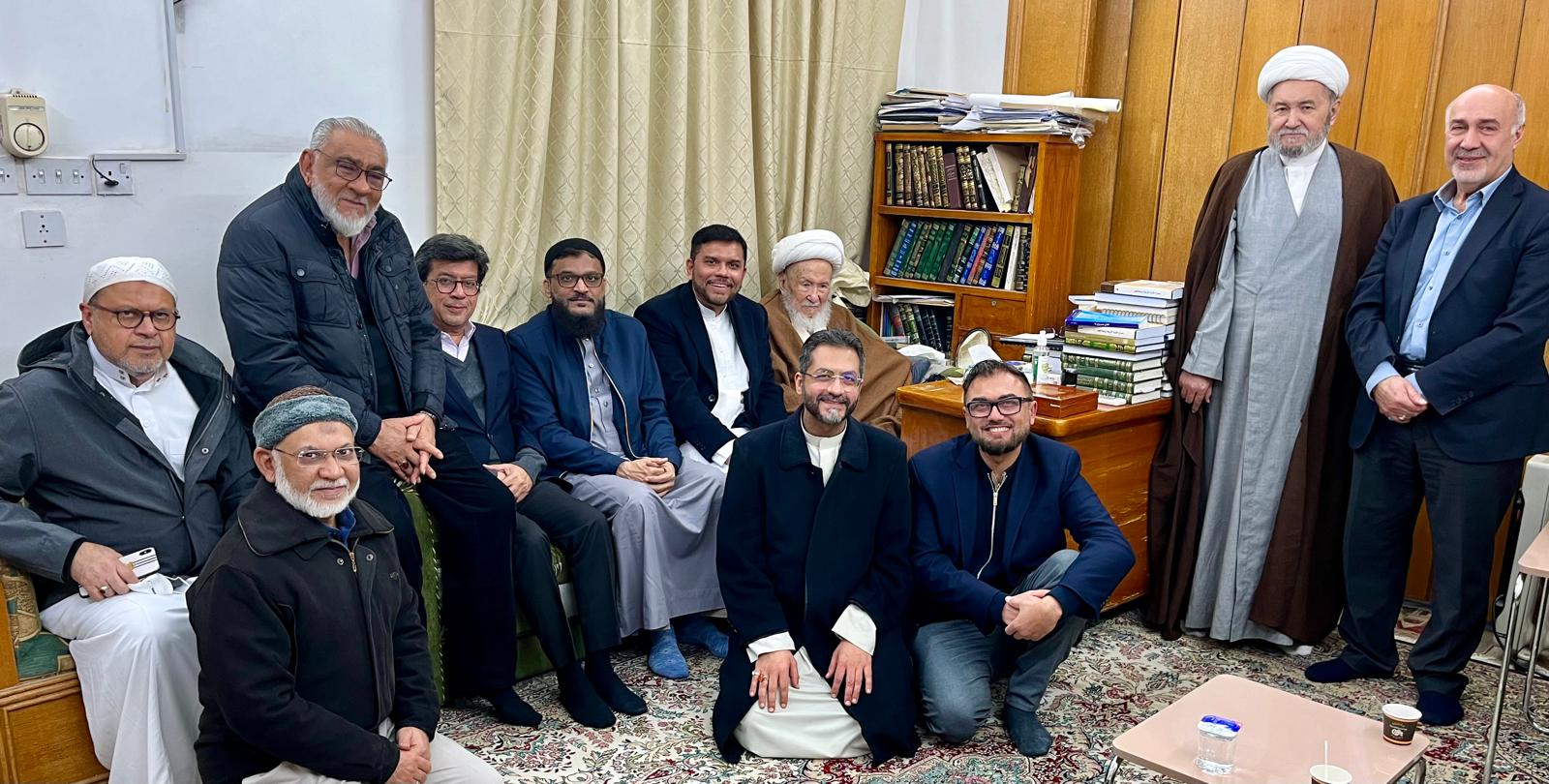
He leaves behind a vast written legacy and generations of students who carry his learning into the seminaries and communities of the world. He is survived by his seven children; his son, Shaykh Maḥmūd al-Fayyāḍ, served as his representative. He was one of the foremost jurists of his age, and embodied a core Islamic principle that learning, sincerity, and perseverance in the path of knowledge recognise neither birth nor border.
May Allah have mercy upon him, and sanctify his soul.